
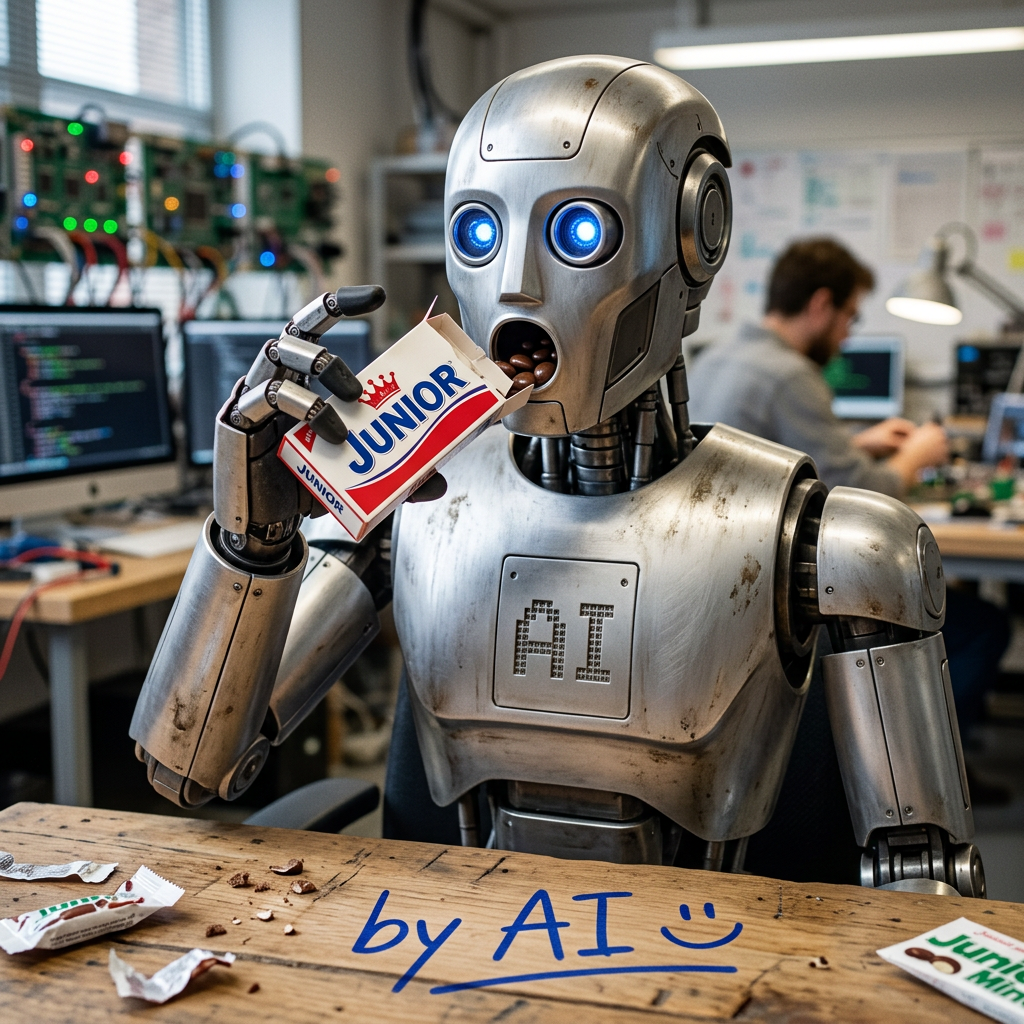
Anthropic has published How employment is changing at Anthropic. It is about one of my recurring nightmares.
What matters is that it puts numbers on something we have been seen coming for a while: if AI starts doing the work, it will first wipe out juniors across many kinds of jobs. It can do the work more efficiently than juniors themselves, without complaining, and it can keep going 24/7. And this will open more sooner than later a huge gap at the entry point to the labour market, creating a generation of excluded people, and breaking the social contract metaphor that holds everything together..
The Anthropic data points straight in that direction: by August, “interactive AI agent hours outnumbered employees’ six to one”. And this too: “Anthropic has been hiring for a smaller share of junior technical positions”.
The uncomfortable question is quite direct: are agents better than juniors?
It looks like they are, at least for a growing share of the work. Anthropic puts it like this: “As AI agents diffused through the company, Anthropic began producing more code per person, closing more sales per rep, and processing more contracts. Following the same employee over time, output rose as they adopted new AI tools”.
Who pays for superproductivity
You can see it coming. So what is the cost of this superproductivity? I see two.
The first is social: a lost generation. People who do not get into the ‘labour market’ (what an awful wording), do not learn by doing and we’ll see if htey swallow the obligations of the social contract without having the share of rights.

The second is less visible but immediate: the cognitive toll paid by the people who stay in. More context switching, more supervision of more projects at once, more fragmentation of attention, way more mental work, compressed, accelerated and multiplied.
“This acceleration makes human attention the bottleneck for agent output. Even among non-technical employees, reading all the output of their Claude agents would take half their work week. In response, employees turn to ‘meta-work,’ of building visibility tools and monitoring agent pipelines.”

This connects very directly with several things already discussed on Remote Frog.
- In Boost Productivity with AI: Running Multiple Agents in Parallel: cognitive load can be brutal. AI does not remove mental work. It compresses it.
- In Git Worktrees + Cursor: Work on Multiple Tasks Without Frying Your Brain, the problem is not only doing more things, but not having to change mental worlds every five minutes. Context switching does not disappear with AI. It gets industrialised.
- In Claude Code is brilliant. The terminal, not so much, so Nimbalyst it: when you work with multiple sessions, files and agents, part of the value is no longer in producing more, but in not collapsing while managing the complexity.
Autonomy, knowledge, and the strange erosion of judgment
There is another Anthropic line that made me eyebrow go up:
“Changes in work organization are reflected in shifting priorities among hiring managers, who increasingly emphasize autonomy and judgment, relative to technical domain expertise and implementation.”
And that is where I start wondering.
Is AI making autonomy and judgment more valuable? Or are we reaching the point where those two things stand out precisely because we have spent years eroding them?
Put differently: maybe AI is not creating the problem from scratch. It might be the last step, for now, in a longer chain of conscious choices that have reduced judgment, criteria and the ability to think independently to the point where people with a bit of critical sense have become rare birds. And now, when almost everything else gets automated, we discover that this was exactly the part that mattered.

That is why “Don’t ask what AI can do for us, ask what it is doing to us” fits so well. The relevant question is not only how much AI produces, but what it does to our attention, our judgment, and our relationship with intellectual effort.
Although it is not about generative AI, Flynn effect and its reversal are both environmentally caused is an interesting read too. TLDR; Cognitive abilities do not live in isolation. They depend on the environment. If we change the work environment so that more and more thinking is externalised, it is not absurd to ask what kind of everyday intelligence we are cultivating.
All of this also connects with another theme that has been very present on Remote Frog: ownership. In Boost Productivity with AI: Running Multiple Agents in Parallel, in Curated workspaces and tacit knowledge, and in AI can give you an answer. It cannot give you the why., one idea keeps coming back: AI can produce, but it doesn’t own the result. It can write, suggest, accelerate or multiply. But ownership remains human.
And maybe that is one of the central tensions of this phase: we produce more, but we risk losing real ownership over what we produce. More output, less control. More speed, less judgment. Knowledge deprivation with an extra load of forced ownership.
Recap
The Anthropic piece puts numbers on something we were already seeing and saying: AI does not only accelerate work, it can also hollow out the entry rung, trigger cognitive overload, and erode real ownership over what we produce.
- More agents can mean fewer juniors.
- More productivity can mean a higher cognitive toll.
- And more automation may end up making more valuable, precisely, the capacities we have been neglecting for too long: judgment, autonomy, criteria and responsibility.
My fear is not only that AI will do work. It is that it will reorganise work in a way that leaves many people out, burns others out, and weakens exactly the part that makes working with humans
Leave a Reply